Jerk Chicken
“Drum Pan Smoke”
The Story
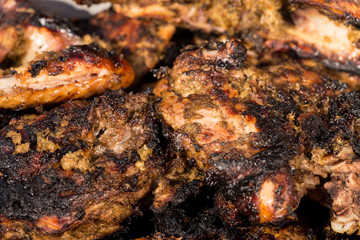
Jerk is Jamaica's single greatest culinary gift to the world, and its origins are as fierce as its flavour. The technique traces directly to the Maroons — the communities of escaped enslaved Africans who fled to the impenetrable Blue Mountains and Cockpit Country of Jamaica in the 1600s and 1700s. Living on the run from British soldiers, the Maroons needed a way to preserve and cook meat quickly, with materials foraged from the dense bush. They discovered that pimento wood — the tree that produces allspice berries — when burned green, created a thick, aromatic smoke that both flavoured and preserved meat. They combined this with a fiery paste made from scotch bonnet peppers, wild herbs, and allspice, rubbed it into wild boar or whatever meat they hunted, and slow-cooked it over the smouldering pimento coals. The result was jerk. The town of Boston Bay in Portland parish is considered the birthplace of commercial jerk — the roadside jerk pits there have been smoking for generations. Today, jerk is cooked all over Jamaica, from the oil drum pans of roadside vendors in Montego Bay to the backyards of every household. The drum pan — a steel oil barrel cut in half and fitted with a wire grate — is the iconic vessel. Miss Vie does not use a drum pan because she says her husband's old charcoal pit 'has more jerk memory in it than any barrel.' She marinates her chicken for two days, not one, because she says 'the longer the seasoning sit, the deeper it go, and deep flavour is what separates a cook from a chef.' The smoke, the heat, the allspice, the scotch bonnet — when they come together over real coals, there is nothing else like it in the world.
Where & when
Era: Maroon freedom fighters (1600s onward)
Region: Portland (Boston Bay), St. James, Cockpit Country
The word 'jerk' likely comes from the Quechua word 'charqui' (dried meat, also the origin of 'jerky'), brought to the Caribbean by Spanish colonisers. The Maroons adapted the preservation concept with their own African spicing traditions and the unique properties of Jamaican pimento wood.
What’s Inside
- Whole chicken
- Scotch bonnet peppers
- Allspice berries (ground)
- Fresh thyme leaves
- Garlic cloves
- Fresh ginger
- Soy sauce
- Brown sugar
- Lime juice
- Scallion
- Black pepper
- Cinnamon
- Nutmeg
- Vegetable oil
- Pimento wood chips
Exact quantities and substitutions are in the full recipe inside the cookbook.
What You’ll Do
- 1.Make the jerk marinade: blend the scotch bonnet peppers, all…
- 2.Score the chicken deeply with a sharp knife — cut slashes to…
- 3.Marinate in the refrigerator for at least 12 hours, ideally…(12-48 hrs)
- 4.Prepare your grill for indirect cooking: light charcoal on o…
- 5.Cover the grill and cook with indirect heat for 45-60 minute…(45-60 min)
- 6.In the last 5 minutes, move the chicken directly over the co…(5 min)
- 7.Rest the chicken for 10 minutes before chopping or serving.…(10 min)
Detailed step-by-step instructions, timings, and chef tips are in the cookbook.
Serving It Right
Chop through the bone with a heavy cleaver and serve on butcher paper or a wooden board. Place festival (sweet fried dumplings) alongside. A cold Red Stripe or a glass of rum punch is mandatory.
Goes well with: Festival (fried dumplings), Hard-dough bread, Roast breadfruit, Coleslaw
Garnish: Squeeze fresh lime over the pieces just before serving
Want the full recipe?
Open Yard Kitchen for exact quantities, full step-by-step method, chef tips, cook-along mode with timers, and unlimited AI guidance from Granny Miss Vie and Chef Marcus.
Open the cookbook